
01
All Semi-finalists
- Written feedback from a Babson-affiliated judging panel
- Certificate naming you a Global Challenge Semi-finalist

Turn a real problem into an innovative business concept through hands-on workshops, mentorship and a final student competition.
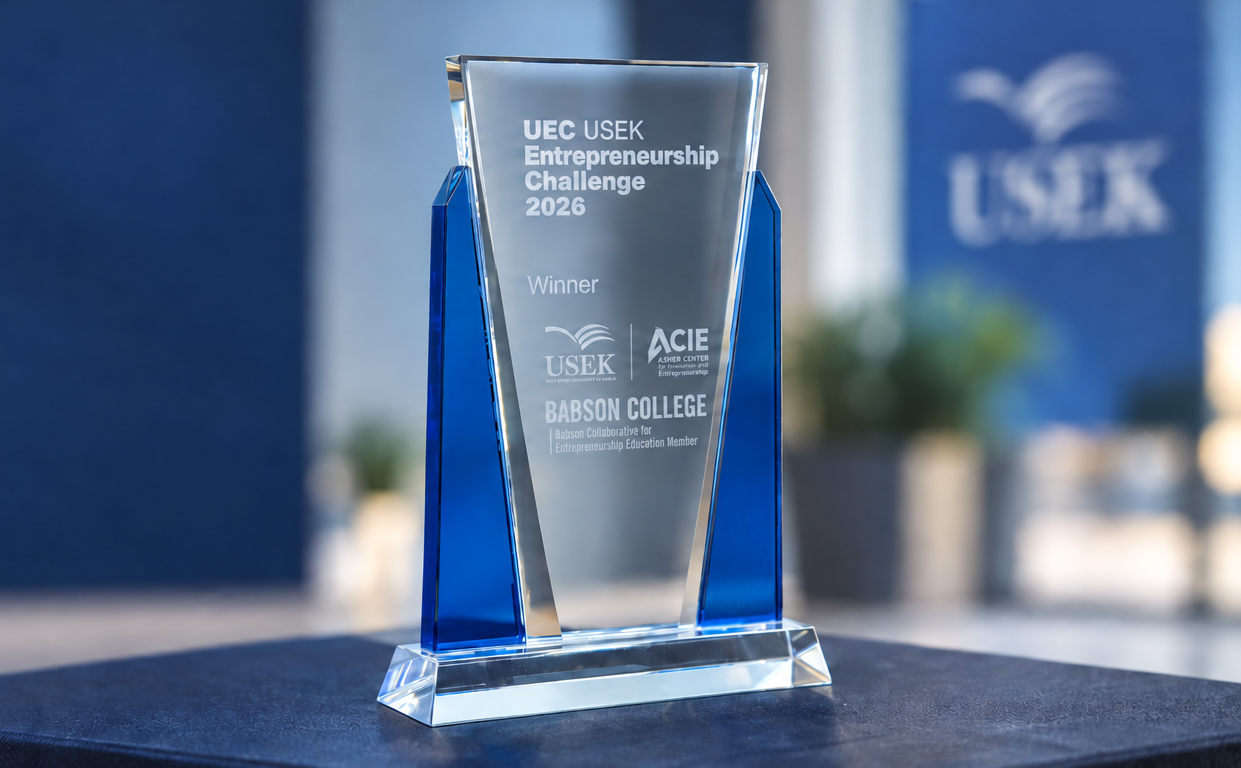
USEK's local challenge within the Babson Collaborative Global Student Challenge.
UEC also connects eligible teams to the EF Hult Prize journey.
What is UEC?
UEC is USEK's annual student entrepreneurship challenge. You work in a team to identify a real problem, shape an innovative business concept, test your assumptions and build a convincing pitch with support from ACIE, mentors and experts.
Four editions of student ideas, teamwork and learning by doing.
Build for impact
Your UEC concept should contribute to one or more UN Sustainable Development Goals. Start with a problem that matters to you, your field or your community.
A few starting points, out of all 17 goals:
Start at USEK. Compete globally.
UEC is USEK's local competition within the Babson Collaborative Global Student Challenge. Top-placing teams move from the university stage into Babson's international competition pathway.
Explore the global challenge ↗
Babson Collaborative Global Student Challenge participation since 2018. Source: Babson College.
If you go global, with Babson
Every stage of the Babson Collaborative Global Student Challenge carries its own recognition, from written judge feedback to cash prizes for the top teams.
Grand prize · 1st place
Every member of the 1st-place team receives a Babson Build Scholarship, fully funded — ACIE covers any remaining costs. July 2027.

A second global pathway
EF Hult Prize supports student teams developing for-profit startups that address at least one UN Sustainable Development Goal. Progress through international selection rounds and receive mentorship at every stage.
US$1,000,000in total seed investment, awarded at the Global Finals
The global award is seed investment subject to EF Hult Prize funding terms. It is separate from UEC and Babson prizes.
Local competition or Open Application, through February 2027.
April–May 2027. National competition or equivalent online selection.
June–July 2027. Validation, prototypes and market-entry plans.
Summer 2027. Intensive development and mentorship.
September 2027. Finalists compete for the global investment.
Advancement at each stage is selective.
How to take part
Applying to UEC does not complete your EF Hult Prize registration.
A low-pressure first step
Join the UEC 2027 Info Session on October 22 at 12:30 PM. Meet the ACIE team, discover the Babson global opportunity and ask anything before applying.
Why join UEC?
A practical journey designed to help you move from curiosity to a clear, tested and pitch-ready concept.
Turn a real problem into a business concept you can develop and test.
Join practical workshops around the real steps of building a concept.
Learn to explain your solution clearly, confidently and persuasively.
Connect across faculties and with the wider entrepreneurship ecosystem.
Compete for the opportunity to represent USEK internationally.
Who can apply?
UEC is designed as a university-wide opportunity. Cross-disciplinary teams are encouraged.
UEC & Babson eligibility
Open to eligible undergraduate and Master's students enrolled at USEK.
Students apply and participate as a team throughout the challenge.
Team members should be enrolled at the same educational level.
Combine different faculties and expertise. Diversity is a team strength.
Your concept should address one or more UN Sustainable Development Goals.
Start with a problem, an idea or an early concept—not only an existing startup.
One member is your team's main point of contact with ACIE and Babson.
Studying at USEK as an exchange student? You're eligible to apply.
Eligibility confirmed against Babson's official 2027 Global Student Challenge Overview and Guidelines.
Meet the criteria? Apply to UEC 2027 ↗EF Hult Prize eligibility
UEC's 2–6 member teams, same-academic-level rule and new-concept-only requirement are specific to the UEC/Babson track and do not apply to EF Hult Prize. Contact ACIE to confirm how your team's participation route works across both.
How EF Hult Prize teams are assessed
Later rounds examine market fit, market-entry strategy, traction and scaling.
Your UEC journey
Find a problem or opportunity worth solving.
Shape your solution and business concept.
Test users, customers, assumptions and feasibility.
Strengthen the model, prototype and value proposition.
Communicate the idea clearly and confidently.
Present at the UEC Final and aim global.
UEC 2027 timeline
Only the dates students need to act on—kept simple and easy to scan.
Campaign and student outreach begin.
Meet ACIE, understand the challenge and ask your questions.
Final deadline for student teams to apply.
Workshops, mentoring, concept development and pitch preparation.
Final teams pitch at USEK.
23:59 GMT. A separate track from UEC — applies only to teams pursuing EF Hult Prize.
Top USEK team follows the international competition pathway.
Questions, answered
No. You can start with a problem, an early idea or a concept you want to explore. UEC helps you develop it.
Yes. UEC is a university-wide opportunity, and cross-disciplinary teams are strongly encouraged.
For UEC and Babson: no, teams should be composed of students at the same academic level, subject to the final 2027 Babson rules. This specific rule does not apply to EF Hult Prize — contact ACIE to confirm Hult's requirements for your team.
UEC and Babson currently accept teams of 2–6 students; EF Hult Prize accepts teams of 2–4. Contact ACIE about the confirmed participation arrangement across both tracks.
Yes. The business concept should address one or more United Nations Sustainable Development Goals.
Connect with ACIE for guidance and watch for any UEC team-matching activities announced during the campaign.
The top USEK team progresses into the Babson Collaborative Global Student Challenge pathway according to the annual competition process.
For UEC and Babson: no, it's a feasibility competition, not a venture competition. You can build on an idea you started thinking about before UEC, but it can't be an active, revenue-generating business. EF Hult Prize also accepts existing ventures that meet its eligibility requirements — contact ACIE to confirm the appropriate participation route.
You can still continue with your team into the Global Challenge even if you graduate between USEK's local final and the global stage. Once your team enters the Global Challenge, though, its members are locked in and can't be swapped.
No. Participating in UEC is free for eligible USEK students.
No. You must complete the separate EF Hult Prize registration and required application submissions.
Applications close November 29, 2026
You do not need to have everything figured out. You just need a place to begin.